EMQ’s With Fiori del Male
EMQ’s With Fiori del Male
Hi everyone! Welcome to another EMQs interview, this time with Fiori del Male. Huge thanks to their singer, songwriter and founder Nunzio Ciccone for taking part.
What is your name, what do you play, and can you tell us a little bit about the history of the band?
My name is Nunzio Ciccone. I’m the singer, songwriter, and one of the founders of Fiori del Male.
Fiori del Male was born in Scampia, Naples, in 1991, around me, my brother Claudio, and a group of musicians who shared that first period with us. The early history included Andrea Palazzo on guitar, Enzo Esposito on bass, and Roberto Zincone on drums. During the following years, the project expanded through different line-ups, including my younger sister Alessia on sax, Armando Vertullo on keyboards, and Danilo Napoli on guitar.
We came from a place full of contradictions, and music became our way of responding to what surrounded us without allowing it to define us.
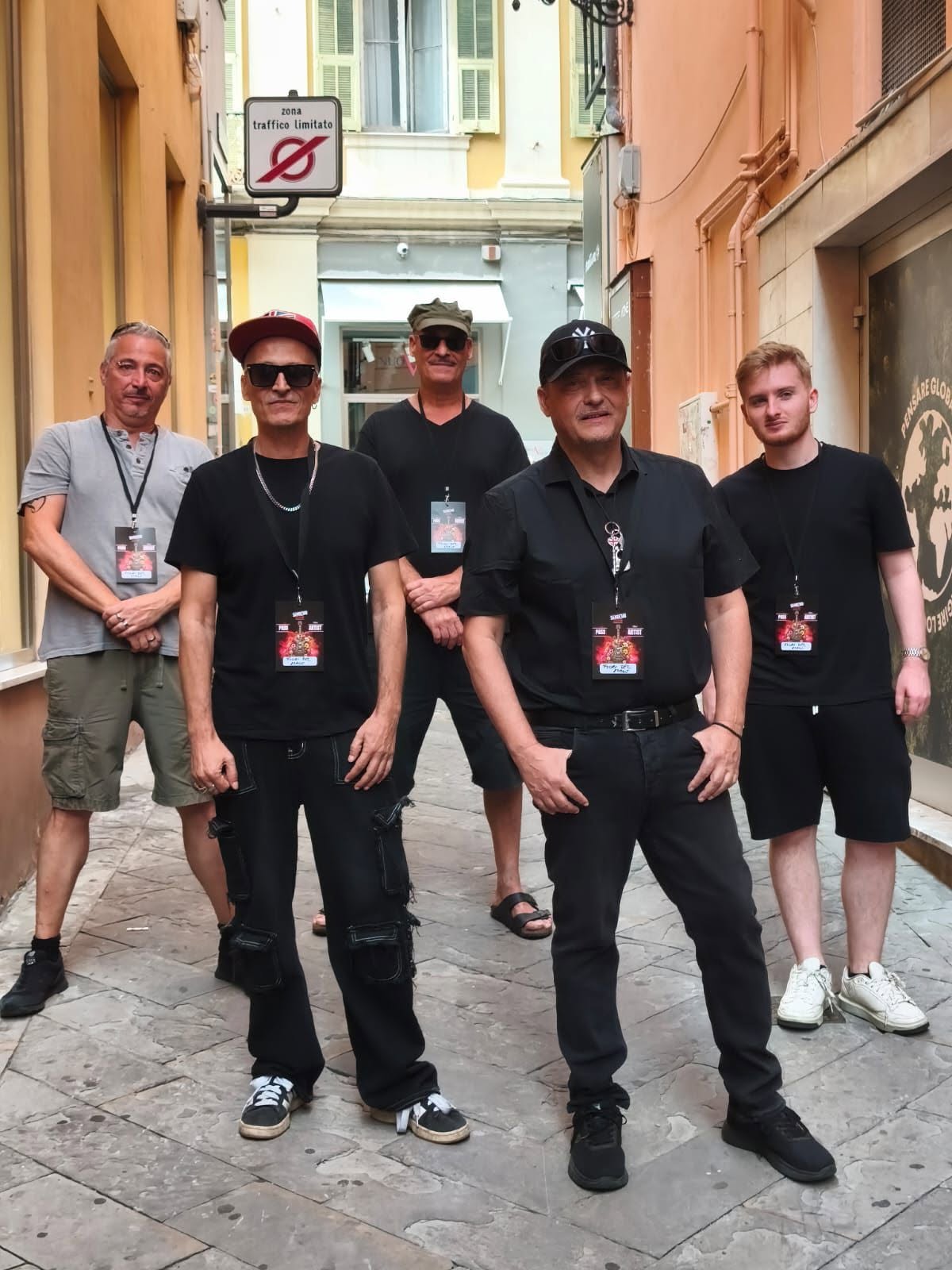
The project later travelled through different personal and musical phases connected with Naples, Milan and London. Thirty-five years later, in 2026, we returned to one of our earliest songs, “Allarme Rosso nel Golfo Persico”, eventually taking it onto the stage of the Teatro Ariston during the Sanremo Rock National Finals.
It has been a very long journey, but in many ways we are still asking some of the same questions we were asking in 1991.
How did you come up with your band name?
The name obviously echoes Baudelaire’s Les Fleurs du mal, but over time it acquired a very personal meaning for us. I describe it as “the resistance of the Flower to the temptation of Evil.” A flower can be fragile, but fragility doesn’t necessarily mean weakness. A flower can grow in difficult ground.
For us, the name became an ethical idea: you can live alongside violence, difficulty, and temptation without allowing those things to decide who you become.
What Country / Region are you from and what is the Metal / Rock scene like there?
We come from Naples, Southern Italy, specifically Scampia. Naples is an extraordinary musical city, but when we began in the early 1990s, being an independent rock band from the northern outskirts meant creating many of your own opportunities. Rock, punk, metal, and alternative music existed alongside an incredibly strong Neapolitan musical identity. We never felt that those worlds had to exclude each other.
That probably explains why Fiori del Male have always been difficult to place inside one genre. We grew up absorbing Italian songwriting, Neapolitan music, British and American rock, punk, progressive music, hard rock and metal.
What is your latest release?
Our latest release is “Allarme Rosso nel Golfo Persico”, officially released in April 2026 but originally written in 1991 during the Gulf War. The important thing is that we did not rewrite the lyrics to make them fit 2026.
For the new recording, we recovered selected parts of my original 1991 vocal from a surviving DAT and combined them with a new vocal and newly recorded instrumentation. Andrea Palazzo recorded rhythm and lead guitars, Enzo Esposito bass, Roberto Zincone drums, while Claudio Ciccone contributed guitar and electronic production. So in one recording you can actually hear the same voice separated by thirty-five years.
We later performed the song at the Teatro Ariston in September 2026.
I don’t consider the song a prophecy. It is a document from 1991. What is unsettling is how naturally some of those words can still speak to the present.
Who have been your greatest influences?
My influences began very early and never followed one straight line.
One of my first musical obsessions was Suzi Quatro. I was about ten and completely in love with her! I asked my father to buy me one of her records. We came home with a Suzi Quatro sleeve, opened it and discovered that inside was actually a record by the Italian band Alunni del Sole. So, through a mistake, I discovered another musical world. Later came Led Zeppelin, Pink Floyd and Yes, and then the enormous impact of AC/DC, Iron Maiden – particularly the Paul Di’Anno period – and The Clash.
Claudio’s route was different at first. He loved Italian songwriting, Riccardo Cocciante, knew Nino D’Angelo’s songs deeply, and Pino Daniele was an important presence in the Naples of those years. Then he discovered Iron Maiden and something changed completely.
We continued through punk, hard rock and metal: Sex Pistols, Scorpions, Saxon, Van Halen, The Cure, G.B.H., Anthrax, Megadeth and eventually Metallica, who became particularly important to our musical direction.
Vasco Rossi was another important discovery for me because I perceived in him an attitude that stood outside many conventions of Italian songwriting.
The influences are very different because we were never really collecting genres. We were collecting languages, emotions and challenges.
What first got you into music?
My father. He loved music and passed that love to Claudio and me when we were very young. He dreamed of playing himself, but life and responsibilities never really gave him the time to pursue it fully. He gave us a German Höfner classical guitar. I still have it after around forty years. It has survived several accidents and has almost become a historical object in our family. Many Fiori del Male songs were born on that guitar, written by me or Claudio.
Later our family home was burgled five times. During one of the major burglaries, instruments and equipment were taken – guitar, bass, amplifier, recorder and other things. They weren’t simply objects to us. They represented dreams we were building inside our home.
Our response wasn’t to reproduce the violence. They took the instruments from our home. Our response was to take the instruments into the streets. That’s when music became more than something we loved. It became a position.
If you could collaborate with a current band or musician who would it be?
Perhaps I would turn the question around: who would like to collaborate with us? After all these years, I wouldn’t choose somebody simply because they are famous. A real collaboration has to begin with mutual curiosity. I’ve spent much of my life searching for music capable of surprising me. Perhaps now I’d like to be surprised by the person who knocks on our door. So… who would like to collaborate with us?
If you could play any festival in the world, which would you choose and why?
Glastonbury, for a very personal reason. During my years in London, I went to Glastonbury in 2000 and saw David Bowie. I remember the concert, but I also remember staying afterwards and watching the sunrise. There was something almost mystical about the place and the surrounding landscape.
I would love to return one day, but this time on the other side of the stage. Of course, I would be happy to play anywhere where there is an audience capable of giving back some of the love that musicians need to continue. Music allows you to dream. Perhaps the healthiest way to keep dreaming is to love the dream without believing the world owes it to you.
What’s the weirdest gift you have ever received from a fan?
A pair of panties. Yes, a pair of panties! Nothing came of it, I should add! We were young, and perhaps rock music at that time also involved breaking conventions and being a little provocative. Looking back, it’s simply a funny memory. Let’s say the gift was received… but there was no follow-up!
If you had one message for your fans, what would it be?
Protect your freedom. Not freedom as a slogan, but the freedom to remain yourself and choose your own direction without losing your dignity. You don’t necessarily need a guitar. Everybody has to find their own “instrument”, whatever that may be. Love what you choose, and protect what makes you free.
If you could bring one rock star back from the dead, who would it be?
Paul Di’Anno. I never had the opportunity to see Iron Maiden live with him. Later I finally saw Iron Maiden with Bruce Dickinson, but that early period with Di’Anno had been an explosion for my eyes and ears when I first discovered it. If I could travel backwards, I would love to stand in the audience at one of those early Iron Maiden concerts, particularly in London in the early 1980s. London would later become my home for twelve years, and my son Jack was born there, so there is another personal connection.
Bringing Paul back would also mean, for me, bringing back a musical moment I discovered when I was young but never had the opportunity to experience in person.
What do you enjoy the most about being a musician? And what do you hate?
What I love most is transforming something personal into something that can belong to somebody else. A song may begin with an emotion, an observation, or a difficult experience. Then someone you’ve never met hears it and recognises something of their own life inside it. That’s extraordinary.
What I dislike is when everything surrounding music becomes more important than the music itself – image, numbers, expectations and calculations. Those things exist, of course, but the reason for making music should come before the mechanism surrounding it.
If you could change one thing about the music industry, what would it be?
I don’t want to judge the music industry or tell other people what the correct model should be. But if I could contribute to one change, I would hope that music would not always be evaluated exclusively in terms of economic return. Of course the industry has to be economically sustainable. But artistic expression also has another value that is much harder to measure: its ability to become a reference point in people’s lives and sometimes across generations.
Music did that for us. Some things cannot be expressed on a balance sheet. Music protected us. Music gave us freedom. I would simply hope that, alongside music’s economic value, we never forget its human and cultural value.
Name one of your all-time favourite albums?
You’re asking for one, but I’m going to cheat and give you three: AC/DC’s Back in Black, Iron Maiden’s Killers and The Clash’s London Calling. They belong together in my memory.
Back in Black had that enormous direct hard-rock power, and “Hells Bells” particularly stayed with me. Killers, with Paul Di’Anno, was an explosion for us. London Calling opened another door through its rebellion, identity, and ability to cross musical boundaries.
But if you absolutely force me to choose only one: Killers.
What’s best? Vinyl, Cassettes, CDs or Downloads?
Vinyl, although that’s probably an emotional answer rather than a technical one. Vinyl takes me back to childhood, my father and that accidental discovery of Alunni del Sole inside the Suzi Quatro sleeve. Digital technology has given music an extraordinary ability to travel around the world instantly, and I appreciate that enormously. But with vinyl, the music, the object and the memory become part of the same experience.
What’s the best gig that you have played to date?
There were concerts in Naples during the 1990s that were fundamental to the history of Fiori del Male, so I don’t want to erase those by calling one performance “the best”. But today I would choose the Teatro Ariston in September 2026. Walking onto that stage with “Allarme Rosso nel Golfo Persico”, thirty-five years after writing it, was extraordinary. For those few minutes, 1991 and 2026 seemed to exist on the same stage.
If you weren’t a musician, what else would you be doing?
That’s difficult because, at one point, I actually had another life already beginning. I qualified as an electronics technician, although my real interests were more humanistic. I continued writing songs, began studying Political Science at university, and later worked with my father as a sales agent. I opened my own business and represented products for the mechanical industry. That could easily have become my life. Then came our experience at United Rock for Europe in Ariccia, and something changed. I gradually left that path and decided to give myself completely to music. Around that period, I wrote a song called “Per amore e per libertà” – “For Love and for Freedom.” Looking back, the title describes the decision surprisingly well. I left a life whose direction I could predict for one I couldn’t predict, but which felt like my own. It wasn’t really a career decision. It was a choice for love and for freedom.
Which five people would you invite to a dinner party?
The first would unquestionably be my father. He passed away in September 2025, so today this question has a very different meaning for me. And once I imagine him sitting at that table again, the other four come naturally: my mother, my brother Claudio, my sister Alessia and my son Jack. So I’m afraid I won’t give you five famous musicians. I would choose my family. If you gave me one impossible dinner, I would simply want my family together again.
What’s next for the band?
We are currently working on our next song, “E non si impara mai” – “And We Never Learn”. Bringing “Allarme Rosso nel Golfo Persico” into the present made us look again at a much larger catalogue from that formative period. Songs including Per amore e per libertà, Fiori del Male, Crisi politica, Voglio tutto, voglio di più and Angeli ribelli are part of that archive. But this isn’t an exercise in nostalgia. We’re asking ourselves which songs still have something necessary to say today. I’m particularly interested in the lyrics. The world has changed and we have changed, but some of the questions inside those songs remain surprisingly alive.We don’t want to reproduce the past. We want to meet it again as the people and musicians we are today.
“Allarme Rosso nel Golfo Persico” opened the door. “E non si impara mai” is the next step.
What Social Media / Website links do you use to get your music out to people? Please include any links
Instagram – Fiori del Male:
https://www.instagram.com/fioridelmale92/
Spotify – “Allarme Rosso nel Golfo Persico”:
https://open.spotify.com/track/1hh1uy4AU23KasC6HnclUU
YouTube – “Allarme Rosso nel Golfo Persico”:
https://youtu.be/OOqlHcn5wHc
YouTube channel – Nunzio Ciccone Bros:
https://www.youtube.com/@nunziocicconebros
There’s a long-standing food-based debate here in the UK. And we’d like your help. So… A Jaffa cake – is it a cake or a biscuit? Discuss!
Cake! I lived in London for twelve years, so I realise I’m stepping into dangerous territory here. But it’s called a Jaffa Cake, so I’m going to trust the name! Although perhaps the Jaffa Cake has the same problem as Fiori del Male: everybody wants to put it into a category, while it seems perfectly happy not fitting completely into one.
Thank you for your time. Is there anything else that you would like to add?
Perhaps just one thing. I still have the old German Höfner classical guitar my father gave us when we were young. After around forty years, several accidents, different homes, and different periods of our lives, it is still with me. Many of our songs began with that guitar. Today, when I look at it, I don’t really see an old instrument. I see where a choice began. Years ago I wrote a song called “Per amore e per libertà.”
Looking back at everything that has happened since, perhaps those words explain the journey better than I ever could.
For love and for freedom.
That’s why I chose music. And perhaps that’s why I’m still here.
Disclaimer: This interview is solely the property of Ever Metal. It is strictly forbidden to copy any part of this interview unless you have the express permission of said party. Failure to adhere to this will be treated as plagiarism and will be reported to the relevant authorities.