
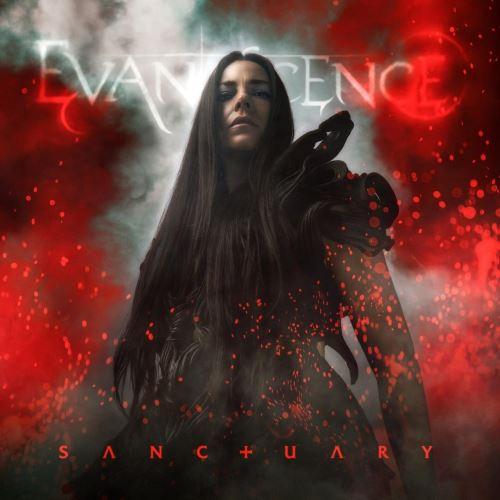
Evanescence – Sanctutary
Evanescence – Sanctuary
BMG/Columbia
Release date: 05/06/26
Review by: Jon Deaux
8/10
Five years into making an album about the guts to confront reality, Evanescence found themselves taking a position that was daring considering the fact that the success of their previous album needed the help of a man to save its climax. No such thing happened on this record.
While some artists earn a legacy and then spend the rest of their lives lying next to it, looking like a golden retriever that has given up on taking any walks in the park, Evanescence has never had such a luxury. It might be related to the fact that Amy Lee has now spent twenty-three years being unable to stop tweaking and adjusting everything, even when there seems to be nothing left to fix. Fallen sold seventeen million copies. Two Grammys. Two songs of the decade. All of these achievements could have ended the life of an ordinary artist on the music scene, but not Lee’s. “What if we turned our next album into an orchestra without guitars? What if we made our next album the most political and aggressive thing we’ve ever produced? What if, five years later, we decided to create an album dedicated to the concept of manufactured confusion, the erosion of reality as such, and, more importantly, the incredible courage of a person trying to grasp something true beyond all of it? What if we called this album ‘Sanctuary’?”
We all got three years of watching the entire world having a documented nervous breakdown, while Amy Lee was busy in the studio working on Sanctuary. While this attitude can be described as impressive creative dedication, I’m not a psychiatrist. I am thus not sure whether she suffers from a clinically significant lack of ability to use coping strategies that do not involve playing piano. I can, however, say that the record she has produced is so well thought out thematically, sonically, and structurally, that it is almost impossible to look for a crack. It’s as if Sanctuary is sitting opposite you, making steady eye contact for forty-seven minutes, and it is not going to apologize to you for keeping you there.
There have been some changes in the lineup that matter. Emma Anzai, who has appeared as the band’s first fully recorded bassist, forced Tim McCord to switch to guitar and Troy McLawhorn’s job. This particular lineup has been praised as a success in numerous interviews with Amy Lee, and this record immediately proved it to be so. With Will Hunt’s powerful drumming and Anzai’s solid bass, Evanescence finally stopped leaning on the orchestra to support the structure of the song, as this new combination allowed Evanescence to go forward with ease. The string ensemble is here, too, as always arranged by Michael Wandmacher, performed by cellist Dave Eggar and conducted by Susie Bench, although the strings here have been restored to their proper place, namely, the complementary one. The change can be heard already from the very beginning of the album and continues until the very end.
The production duties have never been split across two groups until now, but Nick Raskulinecz has handled the sound on five tracks in this case, a man with credits including Rush, Foo Fighters, and Korn, whose primary goal, as he clearly demonstrates on ‘Sanctuary’, is not just to produce the music, but to give it an enormous size. In turn, Zakk Cervini and Jordan Fish handled the seven remaining tracks, with Cervini mixing the whole record. These two groups of producers created an album that features one of the widest tonal ranges in Evanescence’s work since The Open Door in 2006, and yet, there was absolutely nothing inconsistent about it. Every sound chosen for every song was directly influenced by its emotional content, not vice versa.
‘Beautiful Lie’ starts with the usual piano introduction — Lee’s piano, as God and the last two decades of Evanescence’s career have ordered — and accumulates tension for four minutes eleven seconds until it comes to an ungratifying conclusion, refusing to resolve the problem it has been creating all along. It’s as if your psychotherapist decides to book an appointment that lasts exactly fifty minutes but asks you to pay for an hour — and it works brilliantly.
‘Tell Me When You’ve Had Enough’, created under the influence of the ideas by Cervini and Fish, represents what contemporary producers bring into the game. There are some elements of electronics here that are so easily integrated into the song’s structure that you don’t even suspect they were put here intentionally, while Hunt’s drums and the overall rhythm of this particular track prove that Evanescence can produce something truly heavy. Lee’s vocal line in ‘Tell Me When You’ve Had Enough’ has the directness and clarity characteristic of ‘The Bitter Truth’; its chorus has the potential to become a defining element of any concert after the third evening.
‘Who Will You Follow’ became the lead single of this album. Piano and vocals in the beginning, then the band joins in and redefines the song’s message, and finally, the chorus with the precise clarity of Evanescence’s hits and a philosophical depth of somebody who spent three years of his/her life reading explanations to epistemological crises at 2 AM. In other words, it talks about information disorientation, the difficulty in distinguishing reality from delusion and trying to reach something genuine despite all this mess. The song sounds as sincere as described above, and it works because of it — or maybe despite it. That, probably, was the most annoying feature of Who Will You Follow.
Rapture follows Who Will You Follow inwardly after the latter’s outward rush. The track is compact and tight and features a prominent bass line of Emma Anzai as support for Lee’s vocal. Three minutes twenty-nine seconds — that’s how long this song is, but there’s absolutely nothing that makes you feel like it should have lasted longer or shorter.
Afterlife has 150 million streams on various digital platforms right now, has been the top song on Billboard Mainstream Rock Airplay in July 2025, has ended a twenty-two-year chart drought that I assume the band noticed approximately twenty-one years ago. You know that song, as everybody who has been following Evanescence for at least a year must. Its achievement consists not in the song itself, but in a clever sequence choice, allowing this track to appear in the album’s center — not as a commercial insertion that the rest of the album would have to deal with, but as a structural anchor. Most of the artists could not have achieved this result; Evanescence did.
The song with the title of the album is a natural point of transition between the first and the second half of the record. It talks neither about the safety nor escape, but about presence and resistance to all the mess around and the lies that make it worse. It is a song that was written by Lee after a spontaneous idea that came in the middle of an Australian concert in November 2025: it talks about sharing a space of truth instead of an evasion one. The song is as honest as the idea that inspired it, and it summarizes the previous material.
‘How Do I Heal’ is the most personal and open-hearted track on this album, created during a vacation in Hawaii that Lee took together with her family. I’m mentioning this fact not for the sake of giving some biographical information about her, but rather as another example of what can happen when a listener decides whether the lyrics of a certain song deserve eye-rolling or not. Again, your decision will tell you more about you than I can. The strings in this track seem to be especially affecting: they are present here, but there’s never anything too much. Their presence here serves a purpose — namely, as a support for the lyrical content that the voice alone could not carry.
‘About Us’ takes listeners’ attention to a different plane: this track broadens the lyrical perspective of the record and connects it to the rest of the world, not to a single person anymore. This track uses the production density associated with Raskulinecz, and yet it is characterized by the precision of melody construction developed by Amy Lee during the last two decades — heavy and exact at the same time. Four minutes and fifty seconds of this song were not wasted, indeed.
‘Calm Down’ is a song with ironic subtext: it tells us to calm down as if we actually need to do so. Instead, ‘Self Destruct’ talks about recognizing the pattern to break it, while carrying a heavy industrial sound and a precise melody of the band. As per studio notes, this song was created in the last stages of the recording process; the urgency of Lee’s performance confirms that information.
Five minutes sixteen seconds of explicit content is what ‘Forever Without You’ is all about. The structure of the track becomes simpler as it goes on, giving more freedom to the vocal line that, thus, has a bigger chance to speak. This is a song Lee decided to perform as if she had stopped thinking about whether the listeners would be comfortable with her or not. Finally, it goes into ‘Wide Open Heart,’ which closes the album in three minutes and thirty-six seconds of true conclusion. Short and justified, radical not in terms of choice but in terms of its consequences.
It’s safe to say that ‘Sanctuary’ is the result of an album created with a minimal amount of excuses possible for Evanescence — and the band successfully ignored them all. There’s rhythmical power in this work, range in the production, and no repetition or sermons in the lyrics. Amy Lee spent five years working on an album about the courage to accept reality in this epoch, built around lies, and yet, there’s no lecturing in it at all.
I was prepared to dislike this record, but, unfortunately, it made me reconsider my position.
Track listing:
01. Beautiful Lie
02. Tell Me When You’ve Had Enough
03. Who Will You Follow
04. Rapture
05. Afterlife
06. Sanctuary
07. How Do I Heal
08. About Us
09. Calm Down
10. Self Destruct
11. Forever Without You
12. Wide Open Heart
Website: www.evanescence.com
Spotify: open.spotify.com/artist/5nGIFgo0shDenQYSE0Sn7c
Instagram: www.instagram.com/evanescenceofficial
Facebook: www.facebook.com/dvntownsend
Disclaimer: This review is solely the property of Jon Deaux and Ever Metal. It is strictly forbidden to copy any part of this review, unless you have the strict permission of both parties. Failure to adhere to this will be treated as plagiarism and will be reported to the relevant authorities.

